
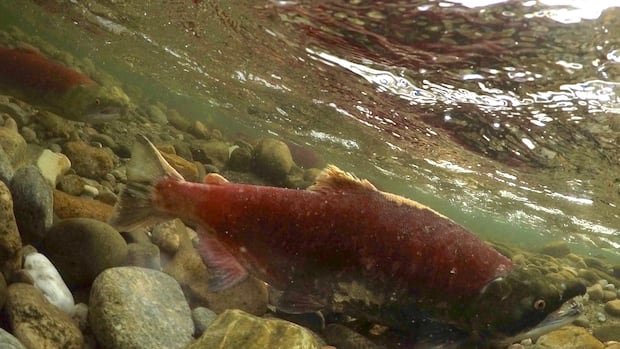

Experts warn that diminished snowpack levels on Vancouver Island could harm salmon populations already struggling due to habitat degradation, overfishing, and warmer temperatures.
The most recent snowpack report indicates that Vancouver Island’s snowpack levels were only at 44% of the normal level as of April 1.
According to scientists, lower snowpack levels will cause rapid snowmelt this spring, leading to decreased water levels and potential drying of pools crucial for adult salmon returning to rivers in the fall for spawning.
Researchers advocate for collaborative efforts between the province and local communities to safeguard watersheds, salmon habitats, and combat the effects of climate change to support salmon populations facing challenges.
“With the impending warmer temperatures this summer, the situation could turn into a catastrophe,” stated Aaron Hill, the Executive Director of the Watershed Watch Salmon Society, concerning the low snowpack levels.
Hill highlighted a concerning trend of alternating droughts and floods in the province, significantly impacting salmon populations.
Tom Balfour, a habitat biologist with the Redd Fish Restoration Society, expressed concerns about potential mass die-offs of juvenile salmon in summer pools on the west coast of Vancouver Island, ultimately affecting larger salmon populations.

Balfour emphasized that the faster snowmelt resulting from reduced snowpack levels could significantly impact the salmon life cycle as they adapt to increased water flow in the spring.
He urged the public to advocate for the implementation of long-term conservation and restoration strategies for watersheds, while also monitoring trapped fish and drying pools during the spring and summer months.
“One critical aspect lacking in our province is sufficient monitoring,” he noted. “Therefore, it falls upon us, the public, to be vigilant and raise concerns when necessary.”
Requesting increased local cooperation, John Richardson, a professor at the University of British Columbia’s forest and conservation sciences department, pointed out that diminished snowmelt in streams and lakes could render salmon more vulnerable to predators.
He suggested that the forestry industry should take active measures to maintain trees near smaller streams to offer vital shade for salmon.
Richardson argued that smaller streams, feeding into larger water bodies, could experience higher temperatures, imposing stress on temperature-sensitive salmon.
“Implementing stream shading is a crucial climate-proofing measure; it is one of the few actions we can take to potentially mitigate the temperature changes in streams associated with global climate shifts,” he explained.
- <a class="similarLink" href="https://www.cbc.ca/news/canada/british-columbia/sal