
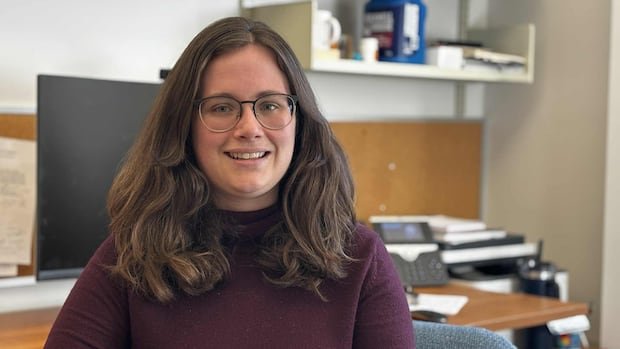

Olivia Daub’s toddler son has a strong affinity for “doodidees,” a term he passionately vocalizes every morning at 5 a.m. Although others may not comprehend his message, Daub is well aware that he is actually referring to blueberries, his favorite tiny, dark blue fruit.
According to Daub, the challenge of deciphering toddler speech is not only prevalent among adults but also poses a significant obstacle for artificial intelligence (AI). As an assistant professor at Western University’s school of communication sciences and disorders in London, Ont., Daub is spearheading a new research initiative aimed at enhancing AI’s understanding of toddler language patterns.
While existing automatic speech recognition software excels in deciphering adult speech, it often falters in accurately interpreting the speech of young children. Daub emphasized the necessity of leveraging AI and machine-learning principles to refine the recognition capabilities for toddlers and preschoolers.
Collaborating with Soodeh Nikan, an assistant professor in Western University’s electrical and computer engineering department specializing in artificial intelligence, Daub is focusing on training an AI model to comprehend toddlers’ unique speech patterns and idiosyncrasies.
Nikan highlighted that conventional speech models primarily trained on adult speech encounter difficulties in accurately interpreting toddler speech, including common pronunciation errors. By incorporating examples of children’s speech patterns and errors, the AI model can distinguish between typical speech mistakes and potential speech disorders.
The research methodology involves engaging 30 children in interactive play sessions, storytelling, and conversations with research assistants. Each session will be meticulously recorded, transcribed, and analyzed to capture the nuances of children’s speech patterns, such as the substitution of sounds like “r” with “w.”
The ultimate goal of this study is to develop an AI model capable of aiding speech-language pathologists in clinical settings by facilitating accurate analysis and transcription of children’s speech. Daub and Nikan envision a future where enhanced AI understanding of preschoolers’ speech could revolutionize tools like closed captioning and voice-activated accessibility software, empowering children to engage more effectively with technology and contribute meaningfully to society.