
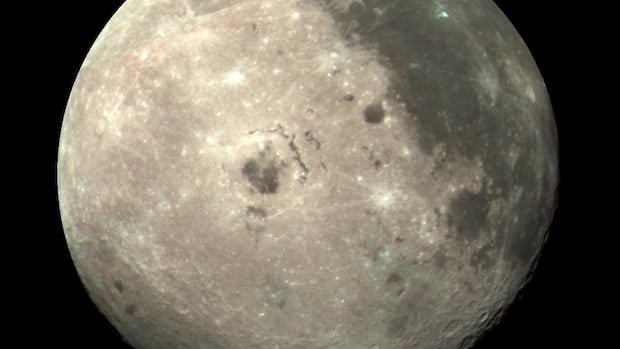

Canadian astronaut Jeremy Hansen will be embarking on the Artemis 2 mission to explore the far side of the moon, a part of the moon not visible from Earth. This mission is of great interest to scientists, as they plan to send telescopes and robots to this unexplored area to delve into deep space.
The moon is unique in that it always presents the same face towards Earth due to gravitational forces. Contrary to popular belief, the far side, also known as the dark side, receives just as much sunlight as the side facing Earth. The far side is characterized by a rugged, crater-filled surface, unlike the near side which features large flat plains known as “Maria.”
Astronomers are particularly intrigued by the far side’s quiet environment, shielded from Earth’s radio noise, making it an ideal location for radio telescopes. Canadian astronaut Hansen will have the rare opportunity to witness sights unseen by many since the Apollo era, as the Artemis mission will take him beyond the moon to a distance of 7,500 kilometers, affording a view of the entire globe.
During the Artemis mission’s flyby of the moon, Hansen and the crew will closely observe the lunar surface, utilizing the human eye to capture subtle details that cameras may miss. These observations are crucial for understanding ground conditions that could impact future spacecraft landings.
A proposed mission to the far side includes the Japanese TSUKUYOMI, a Lunar Meter Wave Telescope, aimed at investigating the early universe during the dark ages. By detecting faint radio signals from neutral hydrogen gas, researchers hope to unravel the mysteries surrounding dark matter’s influence on the evolution of the universe.
Several upcoming missions, including the TSUKUYOMI prototype and NASA’s Farside Seismic Suite, are set to explore the far side of the moon in the coming years. These initiatives will be complemented by additional lunar observatories from NASA and ESA, all contributing to unlocking the secrets of the universe.
While human missions to the moon prioritize establishing a colony and searching for water ice, robotic missions on the far side will be dedicated to peering into the depths of space and uncovering the origins of the universe. This dual approach promises to expand our understanding of the cosmos in unprecedented ways.