
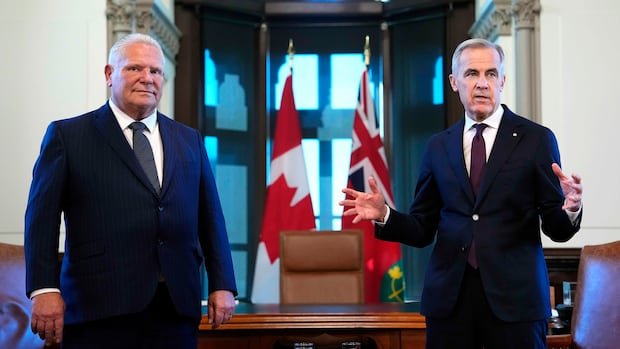

Prime Minister Mark Carney, alongside Ontario Premier Doug Ford, unveiled an $8.7 billion support package for the steel, critical mineral, and auto sectors on Wednesday. The aim of this federal-provincial agreement is to safeguard jobs in vital provincial industries from tariffs and foster the creation of new well-paying positions throughout Ontario.
As part of the collaboration with the Ontario government, $2.5 billion has been allocated over a two-year period to bolster the province’s auto industry for the production of next-generation connected and electric vehicles. Ottawa is contributing $1.5 billion towards the auto funding, with the remaining $1 billion coming from Ontario.
This initiative to support auto companies comes during a period of uncertainty caused by the ongoing trade dispute with the United States. Carney emphasized the importance of a united North American auto sector for enhanced competitiveness and improved job opportunities. However, he acknowledged the shifting priorities of the current U.S. administration, necessitating a corresponding adjustment in approach.
In response to the looming threat of increased tariffs on vehicles and steel by the U.S., Ontario and Canada are facing challenges that are affecting workers and their families across the province. To mitigate the impact, Ottawa has decided to ease greenhouse gas regulations to alleviate pressure on the Canadian automotive sector.
The adjustment in emissions standards involves maintaining 2026 levels for new light-duty vehicles until the 2029 model year, with a plan to resume annual increases starting in the 2030 model year. This shift in policy, while providing some relief to the industry amid tariff concerns, has raised concerns about potential delays in achieving the government’s targets for electric vehicle sales.
In parallel, the U.S. has recently rolled back fuel economy standards, prompting Canada to maintain alignment with its southern neighbor to sustain its automotive industry’s growth. Industry stakeholders emphasize the need for close coordination to ensure the industry’s continued success in both countries.
The partnership between the federal and provincial governments also includes the launch of a $5 billion Joint Steel Action Fund, aimed at modernizing steel mills, diversifying product offerings, and expanding market reach beyond the U.S. Additionally, there is a commitment to invest $1 billion over three years in constructing a road to access the mineral-rich Ring of Fire region, a move that could potentially strengthen Canada’s bargaining power against tariff pressures.
The collaboration between Ottawa and Ontario to streamline the permitting process for mining operations in the Ring of Fire region is seen as a strategic effort to expedite development and leverage critical minerals to counteract the impact of tariffs. Carney highlighted the importance of a coordinated approach to mine permitting, citing historical delays in the process as a barrier to unlocking the region’s potential.