

Canadians across the nation are coming together to commemorate the fifth annual National Day for Truth and Reconciliation, reflecting on the tragic history of residential schools and paying tribute to the children who never returned. Gov. Gen. Mary Simon, the first Indigenous person to hold this position, acknowledged the progress made towards reconciliation while emphasizing the ongoing work required.
During a ceremony on Parliament Hill in Ottawa, Simon highlighted the positive strides, such as inclusive history in classrooms and Indigenous children reclaiming their cultural heritage. However, she noted that significant challenges persist, including inequalities and the need for improved mental health support aligned with traditional healing practices for Indigenous communities.
Simon urged Canadians to use the day to recommit to reconciliation efforts. This year also marks a decade since the Truth and Reconciliation Commission (TRC) released its final report. The TRC’s extensive study revealed the severe impact of residential schools over their more than 100-year operation, forcing around 150,000 Indigenous children to attend institutions plagued by abuse and neglect, resulting in thousands of deaths.
Lucien Wabanonik, Chief of the Anishinaabe council of Lac Simon, shared his personal connection to residential schools, emphasizing the intergenerational trauma endured and the importance of societal awareness and support for healing. Métis elder Charlotte Nolin, a survivor of the Sixties Scoop and an Indian day school, called on all Canadians to actively participate in the reconciliation process, emphasizing that it is a collective responsibility.
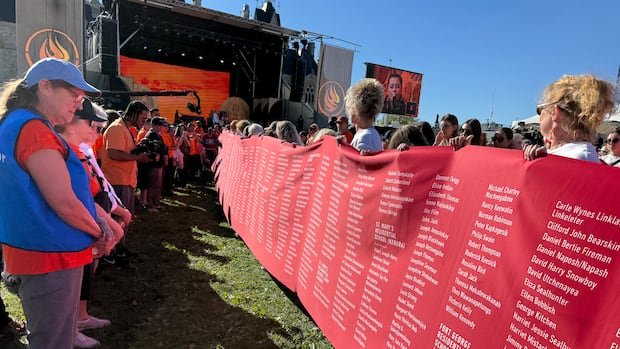
The ceremony featured a drum circle and a poignant moment with a memorial cloth bearing the names of children who never returned from residential schools. Prime Minister Mark Carney affirmed the government’s commitment to implementing the TRC’s calls to action, emphasizing that reconciliation is an ongoing, multi-generational endeavor that demands continuous engagement from all Canadians.
Indigenous Services Minister Mandy Gull-Masty, the first Indigenous cabinet minister overseeing services for First Nations, Inuit, and Métis, reiterated the long-term commitment required for reconciliation. She shared a personal connection to the residential school legacy through her mother, a survivor, highlighting the need to acknowledge and address this dark chapter in Canadian history.
This National Day for Truth and Reconciliation holds added significance following the passing of Murray Sinclair, former TRC chair, who played a pivotal role in advocating for truth and reconciliation. The event emphasized the importance of learning, unlearning, and actively working towards a better future through collective efforts. It serves as a reminder that reconciliation is an ongoing journey that requires dedication and continuous action from all Canadians.