
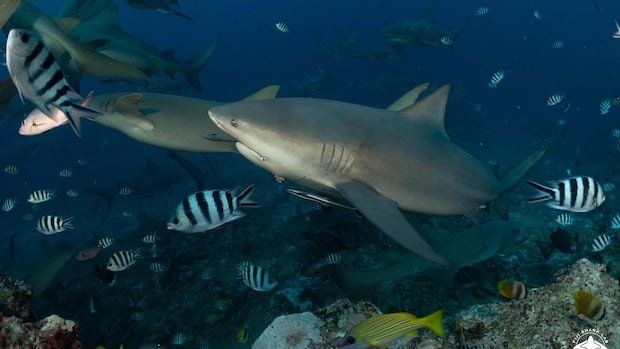

In a recent study published in the journal Animal Behaviour, it has been discovered that bull sharks, often known as aggressive and solitary predators, exhibit complex social behaviors and form beneficial friendships among their own kind. Lead author Natasha Marosi, a PhD student in animal behavior at the University of Exeter and founder of Fiji Shark Lab, conducted the research at the Shark Marine Reserve in Fiji over a span of six years, involving 184 bull sharks.
During the study, researchers observed the sharks interacting within a protected area where they were fed together. The sharks displayed various social behaviors such as parallel swimming and lead-follow movements. They also showed a preference for associating with sharks of similar sizes and gender.
The study revealed that adult sharks formed the core of the social network, with younger sharks being more social to gain information vital for survival. Toby Daly-Engel, director of the shark conservation lab at the Florida Institute of Technology, explained that older sharks, having acquired experience and size, are less social as they face fewer natural predators.
Although the study took place at a provision site where sharks were fed regularly, Marosi emphasized that the observed behaviors were natural and not influenced by the feeding. The findings were also supported by previous studies using different tracking methods, indicating the consistency of the results.
Understanding the social dynamics of sharks, as highlighted by Marosi, can provide valuable insights into their survival and adaptation in the face of human-induced threats like overfishing and pollution. This research not only sheds light on the social nature of sharks but also challenges the perception of sharks as mindless predators, emphasizing their capacity for forming social bonds.