
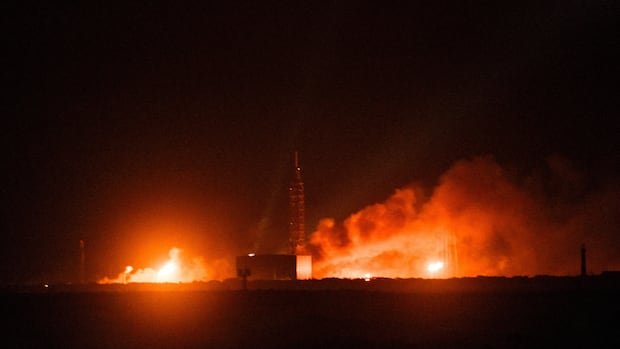

A rocket belonging to Blue Origin experienced an explosion on Thursday evening at the launch pad, causing a disturbance in nearby residences and briefly illuminating the sky with an orange glow. The incident involved the New Glenn rocket during an engine test in preparation for an upcoming satellite launch. Fortunately, there were no injuries reported according to officials at Cape Canaveral Space Force Station.
Blue Origin’s founder, Jeff Bezos, confirmed that all personnel were safe and accounted for. The cause of the explosion is currently unknown, but investigations are already underway to determine the root cause. Despite the setback, Bezos expressed determination to overcome the challenges and resume operations.
The New Glenn rocket had previously encountered issues in April when it failed to place a satellite in the correct orbit due to engine problems. This rocket, intended for NASA missions, including lunar lander deployments, was undergoing testing for its third flight.
NASA Administrator Jared Isaacman acknowledged the complexities of spaceflight and the challenges associated with developing heavy-lift launch capabilities. The explosion of the New Glenn rocket has raised concerns about potential impacts on ongoing programs, such as the Artemis mission.
Following the explosion, residents in Cape Canaveral and Cocoa Beach reported feeling the shockwaves, with social media buzzing with speculations about the event. Emergency crews remained on the scene as a precaution, assuring the public of no immediate threats from the incident.
Despite the setback, officials stated that the explosion would not affect upcoming launches by other companies. The United Launch Alliance (ULA) is scheduled for a launch with Amazon Leo satellites, separate from the mission that the New Glenn rocket was intended for.
Elon Musk, the CEO of SpaceX, expressed condolences to Blue Origin for the incident, drawing on his own experiences with rocket failures. The New Glenn rocket, standing at 321 feet tall, was introduced in 2025 and is a larger and more powerful model compared to the New Shepard rockets used for suborbital space tourism.