
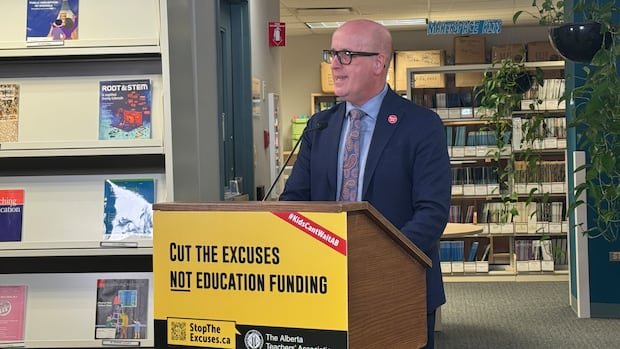

The head of the Alberta Teachers’ Association is advocating for the provincial government to finance class size guidelines set in 2003 after the last major teachers’ strike in the province.
Jason Schilling, the ATA president, mentioned on Alberta at Noon Wednesday that the province’s public, Catholic, and francophone school divisions would have to recruit over 5,000 teachers to achieve the recommended student-teacher ratios in that report.
“We are still evaluating if the government would act on those figures,” Schilling stated on the radio show. “However, evidently, it is not a priority for them.”
These statements come as 51,000 teachers are preparing for a potential strike on Monday.
Schilling and Finance Minister Nate Horner mentioned in individual interviews on Alberta at Noon Wednesday that further discussions between the teachers’ association and employers are unlikely before Monday.
Horner also confirmed that there are no immediate plans to reconvene the legislature ahead of schedule to impose back-to-work legislation on educators.
Commission’s Recommendations on Class Sizes
Following a teachers’ strike in 2002 involving 22,000 educators from 22 Alberta school divisions, the then Progressive Conservative government established the Alberta Commission on Learning (ACOL) in response to concerns about escalating class sizes among educators.
Apart from proposing hundreds of millions in additional education funding to tackle school pressures, the commission examined research and suggested average class sizes of 17 students for kindergarten to grade 3, 23 students for grades 4-6, 25 students for junior high classes, and 27 students for high school classes.

Unless a last-minute agreement is reached, teachers are set to strike on Monday. How do you perceive this? How will you manage with your children? Do you support teachers halting their job action to pursue negotiations?
“The influence of class size on academic outcomes is one of the most analyzed subjects in education,” stated the report from 22 years ago. “Diminishing class size, particularly in the early grades (K-3), has shown to yield academic advantages, particularly for disadvantaged and minority children.”
In 2019