
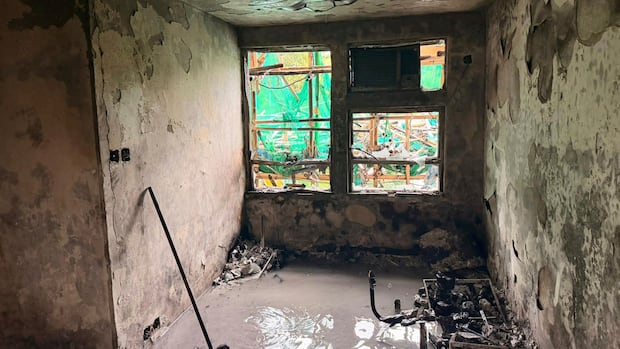

On Monday, officials in Hong Kong announced that their inquiry into a tragic fire that claimed the lives of at least 151 individuals revealed that certain netting covering renovation scaffolding failed to meet fire safety standards. This revelation came amid a surge of public sympathy and support, coinciding with government efforts to suppress criticism.
The fire, which ignited on Wednesday and was not completely extinguished until Friday, began with the lower-level netting that shielded bamboo scaffolding around a building in the Wang Fuk Court high-rise complex. The flames quickly spread inside as foam panels over the windows ignited and shattered the glass. Wind aided in the propagation of flames from building to building, affecting seven out of eight structures enveloped in scaffolding and netting.
Initial examinations indicated that the netting complied with safety regulations; however, further investigations yielded 20 samples from various locations, including higher floors, with seven failing to meet safety standards. This raised concerns that contractors cut corners to increase profits, according to Eric Chan, Hong Kong’s chief secretary.
“They prioritized profit over the safety of people’s lives,” he stated to the media.
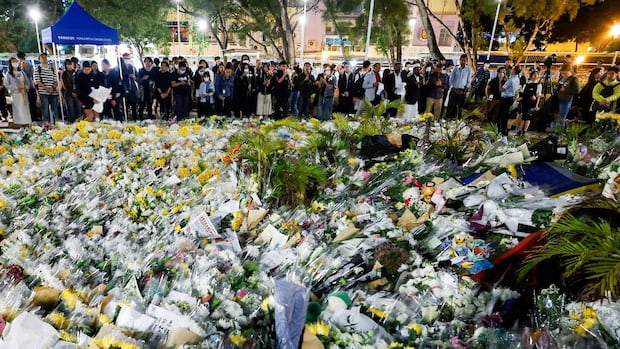
Hong Kong officials said Monday that their investigation into a deadly blaze that killed at least 151 people has revealed some of the netting that covered scaffolding used in renovations was not up to fire-safety codes.
As of Monday, donations for the fire survivors had reached 900 million Hong Kong dollars (approximately $161 million CAD), with many individuals leaving flowers, cards, and other memorials at a makeshift site near the charred remains of the buildings.
“In times of tragedy, we come together to support one another,” remarked Loretta Loh after paying her respects. “My heart feels heavy.”
Approximately 4,600 residents were housed in the Wang Fuk Court complex, situated in the Tai Po suburb.
Challenging Recovery Efforts
Members of the Disaster Victim Identification Unit from the Hong Kong police have managed to search five of the damaged buildings, but progress has been slow on the remaining two, as explained by Tsang Shuk-yin, head of the police casualty inquiry unit. Teams are currently evaluating the safety of the other structures, particularly the one that experienced the initial fire and sustained the most significant damage.
On Monday, authorities recovered eight more bodies, including three that firefighters had previously located but could not retrieve. Many individuals remain unaccounted for, with some likely among the 39 unidentified bodies, Tsang noted.
“A final report will only be possible once we have accessed all seven blocks,” she stated.
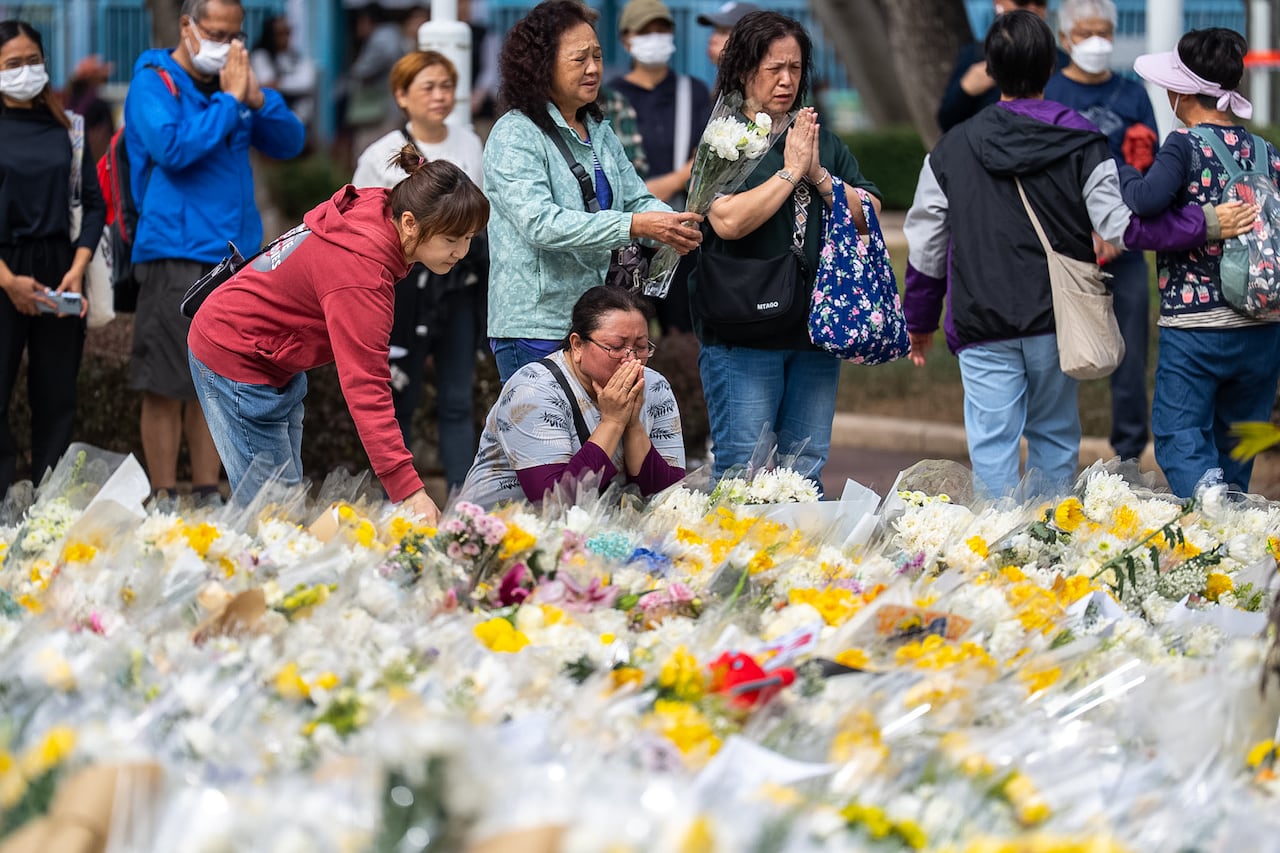
People mourn on Monday at a makeshift memorial near the site of the deadly fire at the residential estate in the Tai Po district of Hong Kong. (Chan Long Hei/The Associated Press)
Local officials indicated that private donations, along with 300 million Hong Kong dollars (around $53.9 million CAD) from the government, will be allocated to assist victims in rebuilding their homes and providing long-term support. The government is also offering cash subsidies to survivors to help cover expenses, including funerals, and is working on housing solutions.
As of Monday, 683 residents had secured accommodations in local hotels and hostels, while another 1,144 had moved into transitional housing units. Authorities confirmed that two emergency shelters remained operational for others in need.
For nearly a year, residents had voiced concerns regarding the construction netting, according to Hong Kong’s Labour Department. It was reported that officials conducted 16 inspections of the renovation project since July 2024 and had issued multiple written warnings to contractors regarding fire safety compliance. The last inspection occurred just a week prior to the fire.
The anti-corruption authorities and police in Hong Kong have detained at least 13 individuals, including the directors and an engineering consultant from a construction firm.
Arrests Linked to Accountability Demands
There has been a growing sentiment among the public that government officials should face accountability as well; however, dissent is increasingly restricted in the former British territory that reverted to Chinese control in 1997, with authorities taking measures to silence public criticism citing national security.
Since the large-scale protests of 2019 against government plans for extradition to mainland China, public dissent has been severely curtailed. Hong Kong now effectively prohibits mass protests and has barred opposition figures from participating in legislative elections.
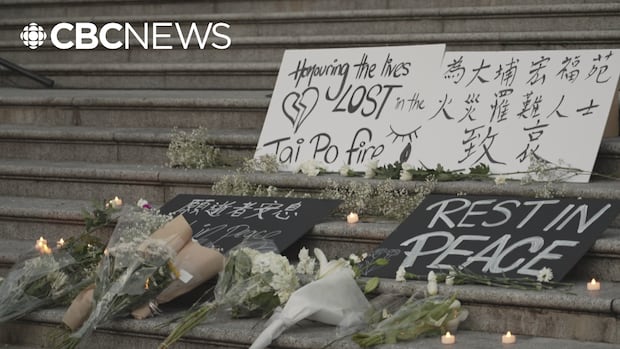
The death toll continues to rise after a massive fire tore through an apartment complex in Hong Kong last week. As Janella Hamilton reports, British Columbians with connections to Hong Kong gathered to honour those who have died and the dozens still missing.
On Saturday, the Office for Safeguarding National Security condemned what it referred to as “evil schemes” intended to exploit the disaster to create unrest and disrupt Hong Kong, though it did not provide specific details.
A man who initiated an online petition demanding government accountability was arrested on Saturday under suspicion of sedition, according to local media outlets including HK01 and Sing Tao Daily. On Sunday, two additional arrests were made, including one of a volunteer who had offered assistance in Tai Po following the fire.
The police refrained from commenting on the specific arrests, stating to The Associated Press that “police will act based on actual circumstances and in accordance with the law.”