
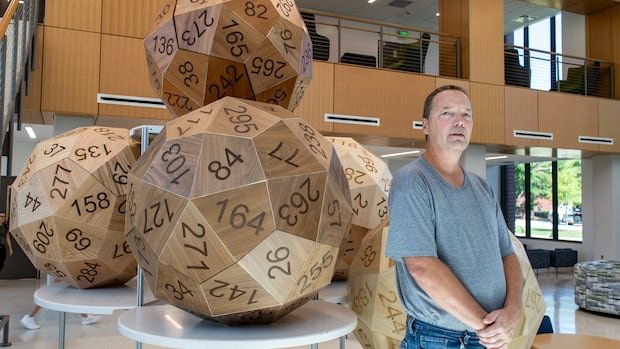

In 2012, mathematician Eric Harshbarger was challenged by a board game designer at a gaming convention to create unique dice that could determine the starting player without the risk of a tie. The objective was to expedite the game setup process and allow players to begin playing promptly.
Harshbarger, a senior lecturer at Auburn University in Alabama, delved into the problem enthusiastically as it presented an intriguing mathematical challenge. After brainstorming, he conceptualized a dice set where each player could roll a die, ensuring an equal chance of winning without the possibility of a tie.
Translating the theoretical idea into a practical solution proved to be a significant hurdle. However, after almost 15 years of research and collaboration, Harshbarger and his team successfully engineered a set of specialized dice named the Go First Dice for five players. These dice enabled a fair determination of the initial player in a board game with a guaranteed winner from a single roll.
Over time, Harshbarger oversaw a diverse group of about 20 computer scientists and mathematicians worldwide who contributed to the project. While creating a set of four 12-sided dice for two, three, or four players was relatively swift, developing a solution for five players posed a more complex challenge.
After exploring various avenues, including the possibility of a die with an impractical 1,440 sides, the team eventually settled on a practical design involving five 120-sided dice. This breakthrough attracted attention, leading to further advancements when Canadian software engineer Paul Meyer devised a solution using five 60-sided dice.
Meyer’s computational approach, based on mathematical patterns and exhaustive computer searches, yielded a successful outcome despite the enormity of the task. The resulting golf-ball-sized dice are now commercially available, although some researchers question their practical application compared to theoretical mathematics.
The research continues as Meyer joins the team to explore the potential for using fewer sides for a five-player set and potentially expanding the concept to accommodate six players. Harshbarger emphasizes the ongoing pursuit of unexpected solutions, acknowledging the allure of tackling seemingly absurd yet captivating mathematical challenges.