
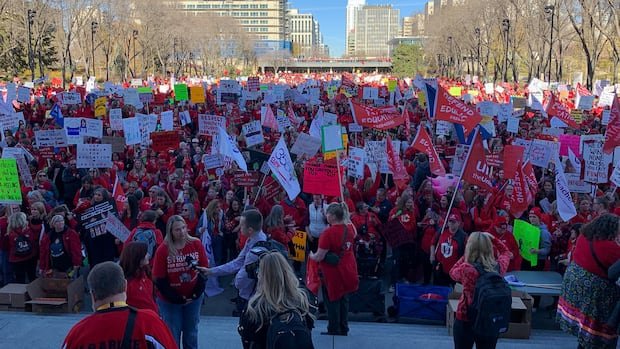

Some Alberta school divisions and a labor expert are expecting a bill to be introduced on Monday to mandate teachers’ return to work, specifying the timeline for resuming classes. Mount Royal University’s human resources professor, Christian Cook, mentioned in an interview on Friday that once enacted, the back-to-work legislation could require teachers to be back in schools within 24 to 48 hours, making any strike action illegal.
The Alberta government, through Finance Minister Nate Horner, plans to present the Back to School Act on Monday with the aim of ending the lockout affecting 51,000 public, Catholic, and francophone teachers who initiated a strike on October 6. While the province’s four largest school divisions are unaware of the exact class resumption date, they are advising families not to send their children to school on Monday until the legislature debates and approves the order.
Edmonton Catholic Schools anticipates that the forthcoming legislation will outline the teachers’ return-to-work schedule, as stated by spokesperson Christine Meadows. The government house leader’s office did not respond to inquiries on Friday regarding the timing of the bill’s presentation and debate in the legislature.
If the government utilizes fast-tracking mechanisms effectively, the bill could be passed by Monday or Tuesday, according to Cook. Employers would have the authority to impose fines or penalties on teachers or their association who fail to comply with the law once it is implemented, with severe repercussions for non-compliance.
Similarly, the back-to-work legislation would end the employers’ lockout that commenced on October 9. Alberta Teachers’ Association (ATA) president Jason Schilling emphasized that a bill prohibiting job actions would also prevent teachers from engaging in work-to-rule practices. Schilling noted that mandating teachers back to work does not address the fundamental disagreements that led to the strike.
The ATA is advocating for a legal mechanism to ensure sufficient staff in schools to cater to the increasing number of students, especially those with complex needs. Their previous proposal included student-teacher ratios phased in over four years, giving priority to students with higher needs.
Premier Danielle Smith has criticized the ATA’s demands as inflexible and suggested addressing classroom complexities by hiring more educational assistants. The government could direct negotiations, mediation, or binding arbitration to reach an agreement with teachers, potentially restricting the discussion topics, as seen in previous attempts to exclude pupil-teacher ratios from talks.
Critics argue that the use of back-to-work legislation infringes on workers’ Charter rights to collective bargaining. If the ATA challenges the law in court, teachers would still be required to report to work during the legal proceedings. Public sector labor unions in the province are closely monitoring the developments and potential impacts on bargaining rights.
In anticipation of schools reopening, Edmonton and Calgary school boards have indicated readiness to welcome students back once teachers resume work. The logistics of making up for lost instructional time and potential adjustments to the school calendar remain uncertain. Some parents express concerns about unresolved issues such as ballooning class sizes and inadequate teacher support, emphasizing the need for meaningful reforms in the education system.