
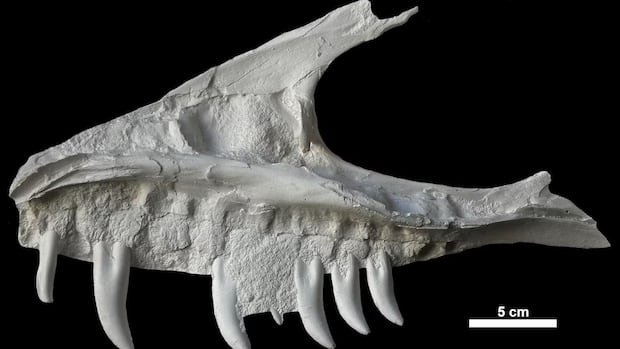

A recent study by University of Alberta researchers revealed that a dinosaur skull unearthed in a British Columbia campground belonged to a lighter and faster tyrannosaur compared to the well-known T. rex. The partial skull impression, dating back 76 million years, was identified as belonging to a horned dinosaur named Gorgosaurus. Lead author Colton Coppock highlighted the unique characteristics that led to the identification of Gorgosaurus.
The discovery began in 2017 when Rick Lambert, a B.C. resident, stumbled upon a peculiar rock at a Tumbler Ridge campground. Lambert’s childhood experience in fossil hunting and a helpful squirrel led him to the first tyrannosaurus skull found in B.C. The Tumbler Ridge Museum Foundation confirmed the significance of Lambert’s find, preserving the original impression for further study.
The well-preserved partial skull bones, including the maxilla, provided valuable insights into Gorgosaurus’ features. The researchers utilized a detailed cast to examine the skull’s internal surface, noting similarities to other Gorgosaurus skull bones. Coppock described Gorgosaurus as a lightly built tyrannosaur with triangular horns and longer limbs, akin to a swifter T. rex.
The study also expanded the known range of Gorgosaurus, indicating its presence from northern British Columbia to northern Montana, covering a vast area of approximately 198,000 square kilometers. The findings suggest that British Columbia holds promise for future dinosaur discoveries, positioning it as a new frontier for paleontological research.
Lambert’s discovery not only signifies the scientific value of the find but also reflects the enduring history of life on Earth. Lambert emphasized the significance of the fossil in showcasing the long-standing existence of life on our planet, highlighting the marvels of our natural world.