
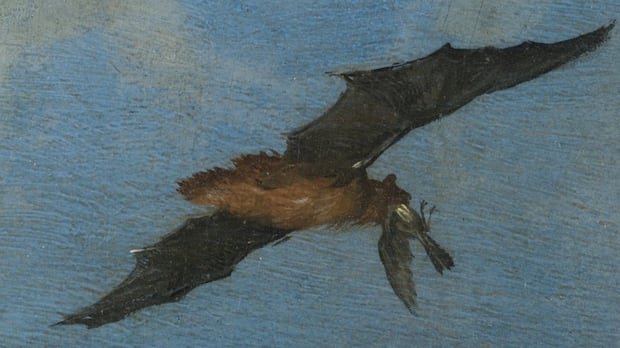

Ecologist Miguel Clavero recently unveiled a fascinating discovery regarding Europe’s largest bat species, showcasing their ability to capture and consume birds while in flight. This behavior, initially confirmed by researchers last year, was further evidenced through a 17th-century painting by Flemish artist Jan Brueghel the Elder, shedding light on the bats’ predatory habits that have been concealed for over four centuries.
Published in the journal Proceedings of the National Academy of Sciences, the study has garnered praise from Mirjam Knörnschild, an animal behavior expert at Humboldt University in Berlin, who commended the integration of modern scientific techniques with historical artwork. Knörnschild emphasized the significance of unearthing valuable biological insights from unexpected sources.
The painting in question, titled “Air,” features a diverse array of birds and bats, with a prominent depiction of a large noctule bat grasping a bird in its jaws. Miguel Clavero, the lead researcher, collaborated with bat experts to confirm this interpretation, highlighting the bat’s unique feeding behavior captured by Brueghel centuries ago.
The investigation into the greater noctule bats’ bird-catching abilities initiated in 2001, following the discovery of bird feathers in bat droppings. Recent advancements in research methodologies, such as equipping bats with tracking devices, have provided concrete evidence of this remarkable behavior. Clavero expressed astonishment at the alignment of historical art with contemporary scientific findings.
While some speculate that Brueghel’s depiction may have been based on artistic liberty rather than direct observation, others like Fiona Mathews suggest the painter may have drawn inspiration from real-life encounters with bats. Regardless of the intent behind the painting, experts like Danilo Russo from the University of Naples Federico II highlight the untapped potential of historical art in unraveling hidden facets of biodiversity and natural history.
The convergence of art and science in unraveling the secrets of wildlife through historical artifacts signifies a promising avenue for future discoveries, underscoring the wealth of knowledge waiting to be unearthed within paintings, manuscripts, and other historical records.