
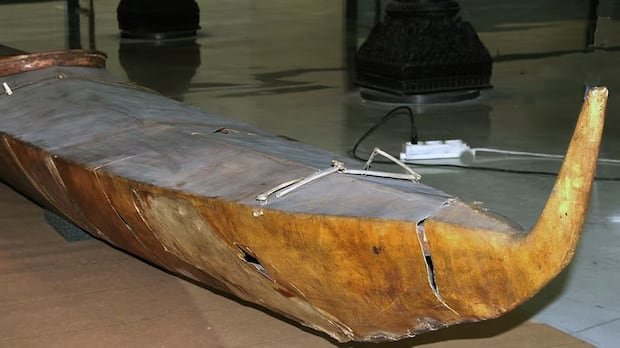

In the depths of the Vatican Museums’ archives, an ancient kayak, weathered by time with its sealskin covering worn but intact, has remained hidden for years. This historic vessel, originating from Western Arctic communities, bears witness to the traditional Inuvialuit hunts of seals, walrus, and whales. Now, it stands as a poignant symbol of reconciliation between the Roman Catholic Church and Indigenous groups in Canada, after intricate negotiations.
The Vatican and the Canadian Catholic Church are reportedly close to finalizing an agreement to repatriate the kayak and other Indigenous artifacts back to their rightful homes before the year concludes. The Canadian Conference of Catholic Bishops (CCCB) has been instrumental in facilitating this significant handover.
In a recent statement, the CCCB emphasized its collaboration with Indigenous Peoples on important matters such as the return of artifacts, many of which are currently housed in the Vatican Museums. The official announcement of the repatriation initiative is expected to come directly from the Holy See in the near future.
The artifacts, including the rare kayak—one of only five in existence—will initially be housed at the Canadian Museum of History in Gatineau, Quebec. There, experts will evaluate their condition, verify their historical context, and collaborate with a committee of Indigenous representatives to determine their final placement.
A confidential source revealed that the transfer process is structured as a “church-to-church” donation, allowing the Vatican to circumvent setting a precedent of returning cultural items directly to nations or communities. This approach mirrors the methodology employed when the Vatican returned fragments of the Parthenon Marbles to Greece in 2023, officially termed as an “ecumenical donation” to the Greek Orthodox Church.
Originally dispatched to Rome in 1925 for a global exhibition organized by Pope Pius XI, the kayak and other items are remnants of a time marked by coerced conversion, cultural suppression, and the oppressive residential school system in Canada. These artifacts, which include a face mask from Haida Gwaii, beaded skin moccasins, birch bark etchings, and an ivory and sealskin sculpture of a dog sled, were part of the vast Indigenous collection housed in the Vatican’s “Animus Mundi” ethnological section.
The impending return of these items holds profound significance for Indigenous communities, symbolizing both a step towards healing and a reclaiming of cultural heritage. The act of restitution has been long-awaited by Indigenous leaders, who view the artifacts as sacred pieces crucial to the recovery journey of residential school survivors.
Fostering reconciliation, Pope Francis acknowledged the importance of repatriation during his visit to Canada in 2023, following which Canadian officials advocated for the return of the objects during discussions in Rome. The Federation of Sovereign Indigenous Nations Chief Bobby Cameron stressed the sacred nature of these artifacts and reiterated the community’s plea for their return.
While the Vatican has formally renounced the Doctrine of Discovery, Indigenous advocates assert that tangible actions like repatriation are essential for genuine reconciliation. Scholars challenge the Vatican’s characterization of the materials as “gifts,” pointing out the coercive circumstances under which they were collected.
As the delicate Inuvialuit kayak and other artifacts prepare to make their journey back, this momentous homecoming signifies not only a physical return but also a tangible step towards addressing decades of cultural loss.