
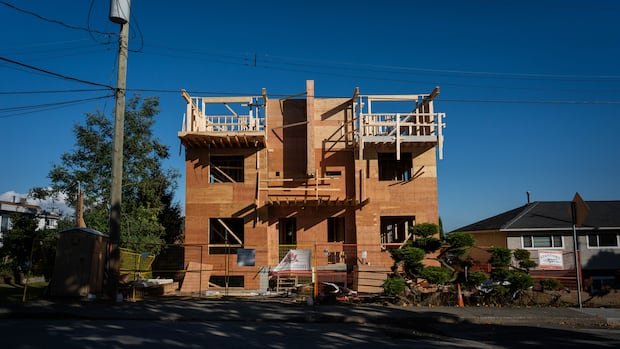

Public outcry regarding the size of newly built multiplex homes in various locations across Burnaby, B.C., has prompted city officials to revise the construction regulations. Consequently, the city will now require smaller multiplex homes with increased on-site parking facilities.
Last July, Burnaby, a city with approximately 250,000 residents situated east of Vancouver, implemented multiplex housing following a provincial directive mandating most B.C. municipalities to permit between four and six homes on single-family lots. In a city characterized by suburban expansion interspersed with highrise structures, multiplex homes are now permissible on any of Burnaby’s 31,000 previously single-family residential lots.
Initially, under Burnaby’s multiplex bylaw, which allows for laneway homes, triplexes, quadplexes, and cottage courts, builders had the flexibility to construct homes up to four storeys high. However, following a recent council decision, forthcoming multiplexes will be limited to three storeys and have reduced floor areas ranging from 33 to 60 percent.
Additionally, developers will now be mandated to provide a higher minimum amount of on-site parking spaces. Burnaby residents, including Tim O’Meara, a retired professional engineer, expressed concern over the visual impact and scale of the new multiplex homes. O’Meara highlighted the significant size difference compared to the original dwellings, expressing apprehension about the effect on property values.
Former B.C. MLA and Burnaby resident, Kathy Corrigan, acknowledged being a proponent of “not in my backyard” sentiments, particularly opposing towering multiplexes that alter the neighborhood’s character. She criticized the provincial and city authorities for relinquishing their responsibility to local communities, contrasting Burnaby’s approach with other municipalities like West Vancouver and New Westminster, which resisted the provincial multiplex legislation.
Mayor Mike Hurley emphasized the city’s responsiveness to residents’ concerns, clarifying that the adjustments were not merely a response to NIMBYism but a recognition of the community’s feedback. He underscored the challenges posed by the provincial mandates, describing them as a standardized approach that does not consider the diverse neighborhood landscapes.
Hurley advocated for multiplex homes within the 1,400 to 1,900 square foot range, contrasting them with the previously constructed 2,600 square foot multiplexes. He cautioned against resistance to provincial legislation, hinting at potential repercussions for municipalities impeding housing development. The Ministry of Housing echoed the need for increased housing options, emphasizing Burnaby’s role as a trailblazer in adopting multiplex housing models.
Bryn Davidson, co-owner of Lanefab, a company specializing in custom home construction, highlighted Burnaby’s recent foray into multiplex housing following the introduction of laneway homes. Davidson acknowledged public resistance to change, citing similar reactions to previous housing innovations like basement suites and duplexes. He emphasized the inevitability of transitional challenges and the importance of adapting to evolving housing trends.
As Burnaby adjusts its multiplex housing regulations, stakeholders like Davidson advocate for measured corrections while acknowledging the community’s concerns and the necessity of balancing housing development with neighborhood preservation.