
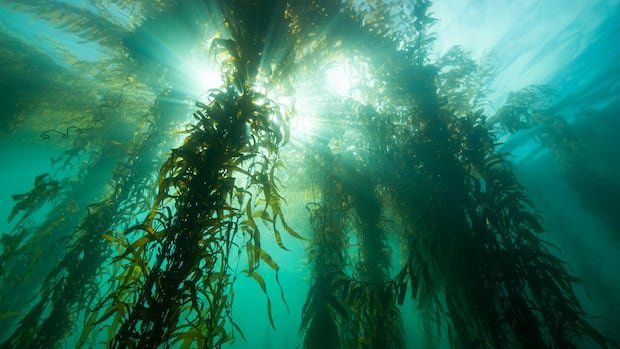

Near the Dallas Road breakwater in Victoria, there are thriving kelp forests beneath the cold waters, according to Brian Timmer, a PhD student at the University of Victoria (UVic). Timmer’s recent study, published in Ecological Applications and based on historical data dating back to 1972, revealed the decline of kelp forests in certain regions due to microclimates causing warming pockets. The study found that the northern Salish Sea, particularly around Comox and Denman Island, used to be covered by over 5.5 million square meters of bull kelp forests, which is ten times more than previously believed.
Satellite imagery shows a significant loss of bull kelp occurred between 1972 and 1984, long before recent heatwaves were thought to be the primary cause. Timmer’s research highlighted a warm water pocket near Comox and Denman Island experiencing substantial ocean warming, affecting kelp populations. Over the past five decades, sea surface temperatures near Chrome Island lighthouse off Denman Island have risen by 0.25 C per decade, totaling 1.66 C increase.
Kelp forests are crucial as foundation species in marine ecosystems, providing habitats and food for various sea creatures. The decline in kelp, particularly sugar kelp and red bladed algae, has been attributed to warming waters along the British Columbia coast. Timmer, working with the Kelp Rescue Initiative and First Nations, aims to restore kelp forests by identifying suitable areas for replanting. This effort emphasizes the importance of conservation and climate adaptation actions based on accurate historical baselines.
William Cheung, a professor at the University of British Columbia (UBC), noted the shifting baseline problem, where current generations may overlook significant environmental changes compared to past baselines. He stressed the importance of understanding historical trends to inform conservation efforts effectively. Timmer’s ongoing work focuses on protecting and restoring kelp habitats to combat the decline in kelp and microalgae communities along the coast of British Columbia.