
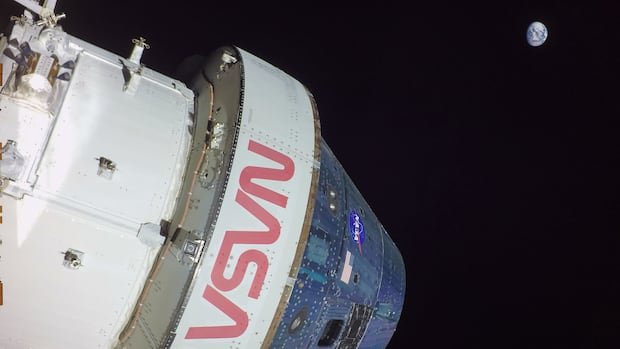

The Artemis II mission is nearing its conclusion within a short span. NASA astronauts Reid Wiseman, Victor Glover, Christina Koch, along with Canadian Space Agency astronaut Jeremy Hansen, have voyaged around the moon aboard their Orion spacecraft, named Integrity, surpassing any previous human distance traveled. Their return to Earth is imminent as they are anticipated to splash down in the Pacific Ocean off San Diego, California, tonight at 8:07 p.m. ET.
The reentry process is intense, with the spacecraft reaching speeds of nearly 40,000 km/h and the capsule heating up to 3,000 degrees Celsius. This journey subjects their bodies to almost 4 Gs, making them feel four times heavier than usual, akin to being under immense pressure.
As they prepare for reentry, the European Space Agency’s European Service Module is set to detach from Orion about 20 minutes before the process begins. Following this, adjustments may be made to Orion’s trajectory through a crew module raise burn, along with roll maneuvers to distance the spacecraft from the service module.
The crucial phase commences as the capsule re-enters Earth’s atmosphere, creating plasma buildup that obstructs communication between the astronauts and NASA ground control for approximately six minutes, known as the loss of signal (LOS) period. Once this blackout concludes, the spacecraft will be around 150,000 feet in altitude, deploying drogue parachutes at 22,000 feet to reduce speed to about 200 miles per hour.
The crew’s protection against the heat is ensured by the Avcoat heat shield. Although modifications were made to re-entry procedures following observations from the uncrewed Artemis I mission, the heat shield remained unchanged for Artemis II.
Upon descending to about 1,800 meters, three main parachutes will be activated to decelerate the spacecraft to a mere 32 km/h, leading to the anticipated splashdown off the coast of San Diego in a swift 14-minute sequence of events.
Following the splashdown, the astronauts will be greeted by the USS John P. Murtha ship, which left in advance of the scheduled splashdown. The recovery process involves transferring the astronauts onto an inflatable raft named the front porch, and upon everyone’s relocation to the front porch, they will be airlifted by two rotating helicopters back to the recovery ship.
After initial medical assessments, the astronauts will return to the Johnson Space Center in Houston. Additionally, the scientific data collected during the mission will be processed, with some findings promptly transmitted to the space center while others require further retrieval.