
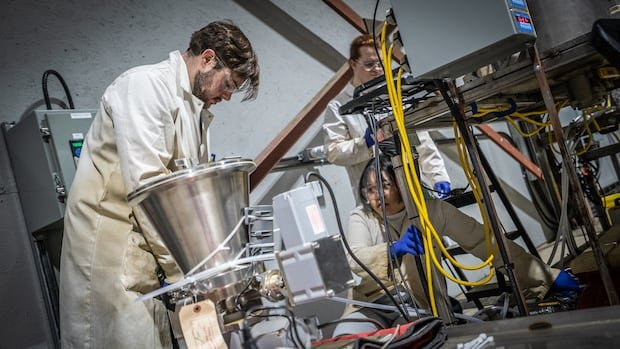

Researchers in Sudbury, Ontario, are actively involved in expanding the utilization of bacteria-powered technology to extract valuable metals from old mine waste. A pilot facility managed by MIRARCO Mining Innovation is currently investigating how microbes can decompose mine tailings, which are the residual rock and sediment from mining activities, to release essential minerals such as nickel, cobalt, and copper through a process called bioleaching.
Although bioleaching technology is well-established in international mining practices, operational at approximately 30 mine sites worldwide, Canada has not yet achieved full-scale commercial implementation, as stated by Nadia Mykytczuk, CEO of MIRARCO, the research division of Laurentian University. Mykytczuk, among others, discussed the advancements during a recent tour of the 10,000-square-foot pilot facility in Sudbury, providing insights into the functionality of bioleaching.
The endeavor to reprocess tailings faces financial challenges, with companies hesitating due to the high costs associated with transporting the material back to the smelter. Consequently, tailings are typically combined with water and stored in large ponds, raising concerns regarding potential long-term environmental hazards.
Jaime Kneen, national program co-lead at MiningWatch Canada, highlighted two primary risks associated with tailings management: chemical behavior and long-term stability. The possibility of generating acid and releasing metals that could gradually seep into the surrounding environment poses a significant concern. To mitigate these risks, tailings are commonly stored underwater, albeit creating a new challenge of maintaining dam integrity over centuries to prevent catastrophic events such as dam failures witnessed at the Mount Polley mine in British Columbia in 2014.
Both federal and provincial authorities are urging increased critical mineral development to secure supply chains for clean energy technologies and national defense, aligning with the surging global demand and the necessity to reduce dependence on unreliable suppliers. Mykytczuk emphasized that bioleaching not only addresses the critical mineral demand but also aids in mining waste cleanup, offering a viable solution to extract substantial amounts of critical minerals promptly.
The bioleaching process involves pulverizing tailings and mixing them with a liquid solution to nourish the bacteria responsible for mineral breakdown. As the bacteria digest the minerals, chemical reactions facilitate the separation and transfer of metals into the liquid medium. Subsequently, the slurry undergoes a series of reactor stages to extract the metals in liquid form, aiming to replicate the process for large-scale mining operations.
Efforts are underway across Canada to explore bioleaching applications, with projects in Nunavut and northern Alberta at various stages of development. Support from the federal Critical Minerals Research, Development, and Demonstration program is aiding initiatives like the Sudbury project to advance technologies towards commercial deployment.
The team is also investigating methods to transform the extracted metals into industrially applicable products. Moving from pilot testing to full-scale operations in Canada within the next few years is the next objective, as Canada aims to establish a full-scale commercial bioleaching operation, nearing the realization of this innovative technology.