
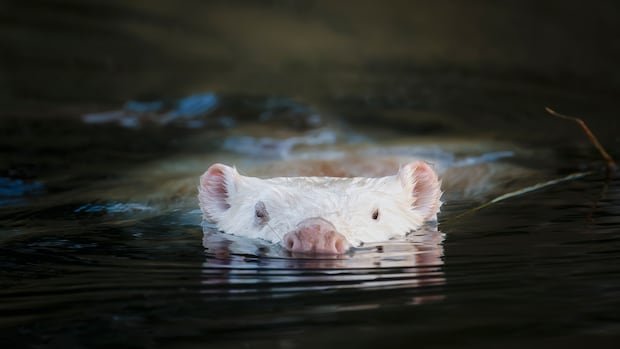

On an autumn evening near Perth, Ontario, a group of wildlife photographers quietly pursued their subject on a river. Using an electric trolling motor, they smoothly moved upstream until a sudden splash broke the silence, signaling the white beaver’s swift retreat underwater upon sensing their presence.
Renowned Ottawa photographer, Dennis Jackson, renowned for his wildlife captures, was taken aback by the rare sight of the white beaver. After initially spotting it during a prior boat outing with a neighbor, Jackson eagerly returned to the river accompanied by esteemed Canadian naturalist Michael Runtz, his wife Britta Runtz, also an accomplished photographer, and a CBC journalist.
While hoping for another glimpse, Jackson aimed to uncover the mystery: was the white beaver an albino, a challenging survival scenario due to impaired vision in most albino animals, or a leucistic beaver with partial pigmentation loss?
As dusk settled, the elusive white beaver reappeared, though its reaction to the human presence remained uncertain. Gliding past the boat underwater, its pale tail flashed before emerging near a cluster of reeds to groom its coat, revealing dark fur on its front paw and distinctly dark eyes. Michael Runtz, identifying the characteristics, deduced it to be a leucistic beaver, citing the presence of dark eyes as evidence.
The retired Carleton University professor expressed delight at the encounter, emphasizing the rarity of a completely white beaver with dark features. Capturing the moment with photographs added to their joy, underscoring the significance of the documented sighting.
While color mutations can occur in beavers, lighter coats may pose increased visibility risks to predators. The Canadian Museum of Nature even houses a leucistic beaver pelt from 1918, highlighting the infrequency of white beavers. Dominique Fauteux, a mammalogy specialist at the museum, noted the scarcity of white beavers evolutionarily, suggesting limited benefits for the mutation’s persistence over time.
For Jackson, the sighting’s uniqueness overshadowed its scientific implications, labeling it as one of his most memorable experiences as he guided the boat back home.