
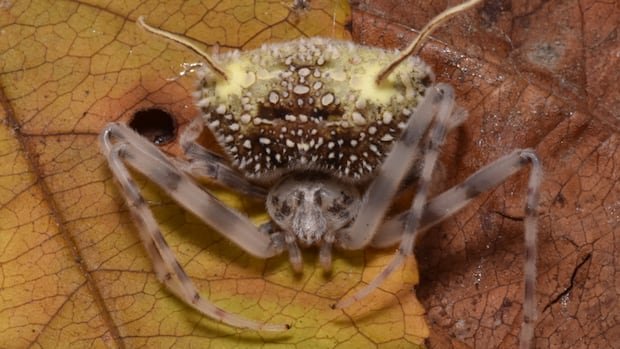

In a surprising encounter during a guided tour in August 2025, scientist Alexander Bentley prodded a mysterious mass covered in what seemed to be a lethal parasitic fungus, only to discover a living spider beneath it. Bentley, a herpetologist in Ecuador familiar with cordyceps, a parasitic fungus known for its appearance in the post-apocalyptic franchise “The Last of Us,” encountered a spider with tubercles on its abdomen, resembling a cordyceps-infected host.
Initially mistaking the spider for a fungal-infected specimen that survived, Bentley later identified it as a new arachnid species mimicking fungus like cordyceps, potentially for hunting or defense purposes. Published in Zootaxa, the findings of this unique spider have sparked both celebration and skepticism among scientists.
Upon observing signs of life in the spider, Bentley sought insights from the citizen-science platform iNaturalist, where users proposed the spider’s resemblance to the parasitic fungi gibellula of the Cordycipitaceae family. Collaborating with co-author David Ricardo Díaz-Guevara, Bentley confirmed the spider as a novel species named Taczanowskia waska after meticulous morphological analysis.
The discovery, hailed by experts like mycologist Monika Fischer, underscores the value of citizen science platforms like iNaturalist. The spider’s uncanny resemblance to cordyceps has led to theories of aggressive hunting tactics or defensive mimicry to deter predators, although further research is needed to validate these hypotheses.
Notably, the spider’s peculiar features, resembling late-stage cordyceps, have intrigued researchers like Andrew Swafford, suggesting a groundbreaking discovery in mimicry behavior among arachnids. Bentley regards this find as a rare and extraordinary revelation in his rainforest explorations, surpassing all previous discoveries in its uniqueness and scientific significance.