
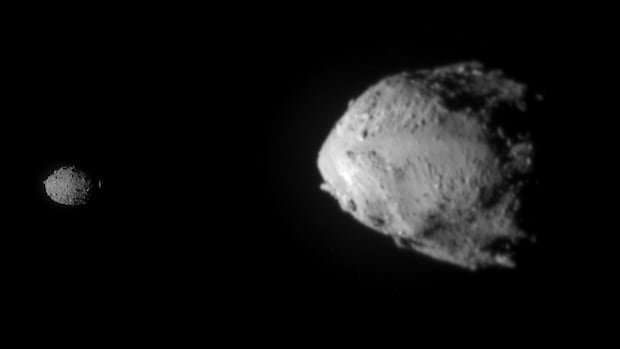

NASA’s recent mission has revealed groundbreaking evidence indicating that asteroids can indeed be redirected, showcasing the potential to protect Earth from potential catastrophic collisions. The importance of this capability stems from the varied sizes of asteroids, ranging from small objects creating spectacular fireballs with sonic booms to larger ones capable of global devastation or even extinction events.
In 2022, NASA’s Double Asteroid Redirection Test (DART) spacecraft intentionally collided with Dimorphos, a moon orbiting the larger asteroid Didymos, after a 10-month journey to the binary asteroid system. The successful mission, located around 11 million kilometers from Earth, resulted in Dimorphos experiencing a shortened orbit around Didymos by approximately 32 minutes. A new study in Science Advances also revealed that the collision slightly altered the pair’s trajectory around the sun.
Lead author Rahil Makadia, a planetary defense scientist from the University of Illinois Urbana-Champaign, emphasized the significance of these findings in advancing Earth’s protection. Rather than destroying asteroids, the study suggests that a small nudge well in advance could potentially divert a threatening asteroid away from Earth.
The decision to target a binary asteroid system for the mission was deliberate, as it allowed for easier measurement of orbital changes. This system, where Dimorphos orbits Didymos every 12 hours while the pair orbits the sun in over two years, facilitated rapid detection of orbital modifications. This approach also served as a demonstration of planetary defense, showcasing how a similar technique could be employed to divert an asteroid on a collision course with Earth.
The impact of the collision was meticulously tracked using radar measurements and stellar occultations, revealing a significant slowdown in the asteroid system’s orbit. The observed heliocentric orbit change, a first of its kind, amounted to 11.7 microns per second, equivalent to about 360 meters per year.
The successful DART mission not only provides a crucial data point for future asteroid-deflection strategies but also offers insights into enhancing momentum to effectively redirect asteroids. These findings pave the way for planning future kinetic impact missions with a reliable method to predict the extent of asteroid redirection.
Overall, the achievements of the DART mission bring reassurance in humanity’s ability to safeguard Earth against potential asteroid threats, highlighting the advancements in planetary defense strategies.