
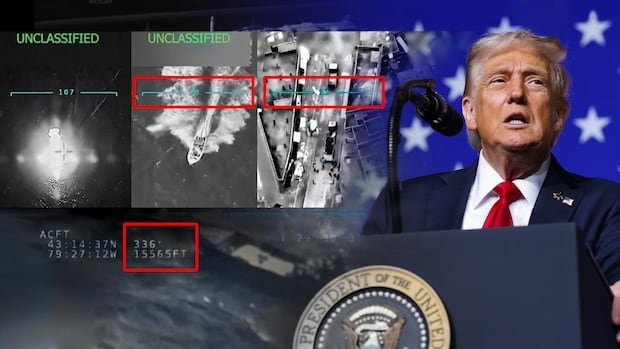

A modern Canadian-manufactured camera system was reportedly utilized in contentious U.S. operations against suspected Venezuelan drug vessels, as revealed in a document by the non-governmental organization Project Ploughshares, exclusively shared with CBC’s visual investigations team. After examining the Project Ploughshares report, cross-referencing it with product manuals and existing videos, and consulting with former military and defense industry specialists, CBC concluded that it is highly probable Canadian technology was employed for surveillance during the missions.
Kelsey Gallagher, a senior researcher at Project Ploughshares, emphasized the necessity for increased human rights oversight, pointing out concerns regarding the misuse of Canadian weaponry. The Project Ploughshares report highlighted that the U.S. military employed a Canadian-made L3Harris WESCAM MX-Series sensor system to monitor and track boats targeted in the strikes originating from Venezuela.
Upon notifying L3Harris WESCAM about the visual analysis findings, the company declined to comment on military missions as a standard policy. The U.S. military conducted a series of five strikes in the Caribbean starting last month, targeting vessels allegedly involved in drug smuggling activities linked to “narcoterrorists,” according to President Donald Trump.
The legality of the strikes has been questioned by experts, raising concerns about potential violations of international human rights and maritime laws. Alexander Avina, an associate professor at Arizona State University, suggested that Canada could be implicated in the war crimes committed by the Trump administration in the Caribbean basin. The White House defended the strikes, labeling them as actions against a terrorist organization and claiming they were in self-defense and in accordance with the laws of armed conflict.
Global Affairs Canada acknowledged being aware of the U.S. operation and stated that they are monitoring the situation. The Project Ploughshares report disclosed that Canadian surveillance technology played a role in executing the initial two strikes. The MX-Series electro-optical/infrared (EO/IR) systems, designed to support intelligence, surveillance, reconnaissance, and target acquisition missions, are manufactured in Canada by L3Harris WESCAM, a subsidiary of L3Harris Technologies, a major U.S. defense contractor.
The investigation conducted by Project Ploughshares highlighted the use of Canadian-made surveillance technology in various conflict zones, including Turkey, Ukraine, and other regions. The distinctive visual elements observed in the Venezuelan strike videos closely resemble those in videos from Turkish and Ukrainian military operations utilizing MX-Series systems.
Expert analysis and visual comparisons further suggested the likelihood of MX-Series system usage in the initial U.S. strikes. Concerns were raised about potential loopholes in arms control regulations in Canada, prompting calls for enhanced oversight to prevent arms exports from being used in abusive ways.