
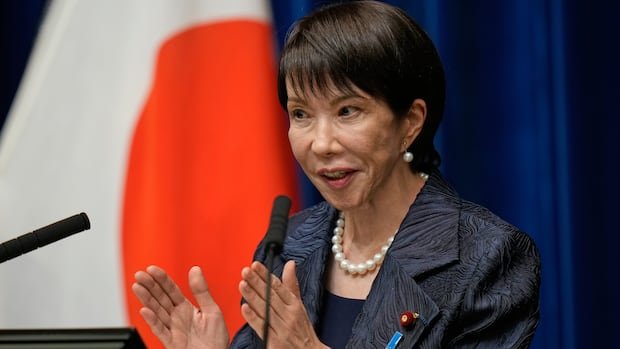

Hardline conservative Sanae Takaichi made history by becoming Japan’s first female prime minister on Tuesday, breaking through the nation’s traditional gender barriers and signaling a potential shift towards a more conservative direction. Takaichi, a protege of former Prime Minister Shinzo Abe and an admirer of Margaret Thatcher, secured 237 votes in the lower house election for the next premier, out of the 465-seat chamber.
European Commission President Ursula von der Leyen congratulated Takaichi on social media, acknowledging her groundbreaking achievement and expressing eagerness to enhance the EU-Japan partnership under her leadership. Prime Minister Mark Carney also extended his congratulations to Takaichi and thanked outgoing Prime Minister Shigeru Ishiba for his service and leadership.
Takaichi’s victory, as Japan’s 104th prime minister, signifies a significant milestone in a country where male dominance has prevailed. However, her election is anticipated to steer Japan towards a more right-leaning stance on issues such as immigration and societal matters.
The coalition agreement reached between Takaichi’s Liberal Democratic Party (LDP) and the right-wing Japan Innovation Party, known as Ishin, paved the way for her victory. Despite holding a majority in the lower house of the National Diet, Japan’s parliament, the coalition remains two seats short of a complete majority.
In response to public discontent over rising prices after years of deflation, Takaichi is expected to follow a similar economic approach as Abe, focusing on government spending to revitalize the economy. This strategy, dubbed the “Takaichi trade,” has propelled the Nikkei share average to record highs. However, concerns have arisen among investors regarding the government’s ability to sustain additional spending in light of Japan’s substantial debt burden.
Tadashi Mori, a politics professor at Aichi Gakuin University, emphasized the importance of securing support from opposition lawmakers for Takaichi to effectively govern. Reviving “Abenomics” may encounter challenges in the current inflationary environment, potentially weakening the yen, as highlighted by Mori.
Emphasizing defense and national security, Takaichi vowed to elevate Japan’s defense spending, strengthen collaborations with the United States and other security allies, and advocate for revisions to Japan’s pacifist constitution. She has taken conservative stances on issues like same-sex marriage and marital surname options.
Having a background rooted in politics, Takaichi began her political career by winning a lower house seat independently in 1993 before joining the LDP in 1996. She is married to former LDP politician Taku Yamamoto, who suffered a stroke earlier this year, leaving him partially paralyzed.
In her cabinet appointments, Takaichi appointed two women—Satsuki Katayama as the first female finance minister and Kimi Onoda as economic security minister. Takaichi aims to increase female representation in the cabinet, addressing a historical deficiency compared to Japan’s G7 counterparts.
Katayama, a former Finance Ministry bureaucrat with expertise in fiscal matters and currency diplomacy, is recognized for her assertive decision-making style, contrasting with her predecessor’s reserved approach. Shinjiro Koizumi is slated to serve as Japan’s defense minister, while Toshimitsu Motegi will assume the role of foreign minister.