
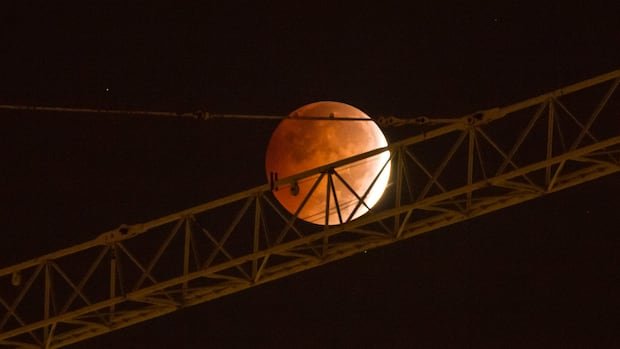

In the early hours of Tuesday, a total lunar eclipse is set to occur across Canada as the moon passes through Earth’s shadow. The visibility of the eclipse varies depending on the location. Western Canada, including B.C. and Yukon, will witness the entire eclipse, while the Prairie provinces will miss the event as the moon sets in the west. In Atlantic Canada, the eclipse will only be partially visible.
To observe the eclipse, individuals will need to rise early or stay up late, depending on their location. Unlike solar eclipses, lunar eclipses occur over a span of hours with distinct phases. Initially, the moon traverses Earth’s faint outer shadow known as the penumbra, where no noticeable change in brightness occurs. Subsequently, the moon enters the darker inner shadow called the umbra, leading to a partial phase where part of the moon may seem dimmer or disappear.
During a total lunar eclipse, the entire moon enters the umbra, resulting in a striking reddish or orange hue, often referred to as a “blood moon.” This coloration is due to Earth blocking direct sunlight and filtering the light that reaches the moon through its atmosphere. The scattering of short-wavelength colors like blue and the passage of longer-wavelength colors like red contribute to the moon’s distinctive coloration.
The eclipse’s progression can be tracked with specific timings. The penumbral phase begins at 3:44 a.m. ET/12:44 PT, with minimal visible changes. The umbral phase commences at 4:50 a.m. ET/1:50 a.m. PT, causing the top left portion of the moon to darken. Totality starts at 6:04 a.m. ET/3:04 a.m. PT and concludes at 7:03 a.m. ET/4:03 a.m. PT before transitioning back to a partial eclipse.
While viewers in the eastern time zone may miss the totality phase as the moon sets, those in Alberta, Saskatchewan, and Manitoba will witness the entire totality phase before the moon sets during the partial eclipse. For accurate timings based on location, individuals can refer to TimeandDate.
Paul Delaney, a professor emeritus of physics and astronomy at York University, advises eclipse watchers to dress warmly and plan photography shots considering the moon’s position relative to the surroundings. Moonset may limit the duration of totality, and the moon’s low positioning could offer unique photographic opportunities.