
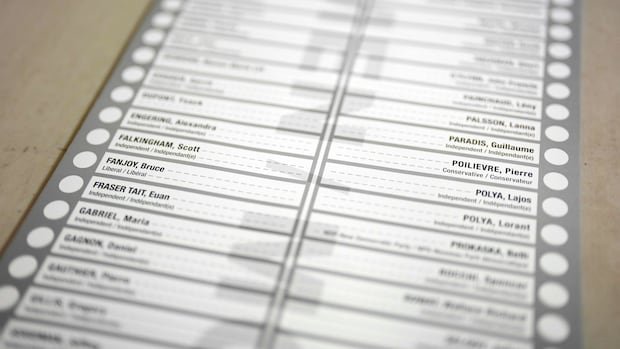

MPs questioned a representative involved in coordinating a series of long ballot protests for his role in increasing the number of candidates in various federal ridings over recent years. Tomas Szuchewycz, an organizer with the Longest Ballot Committee, defended the group’s actions during a contentious House procedures committee meeting on Tuesday. He advocated for MPs to abstain from setting election rules and proposed the establishment of an impartial body to regulate election procedures.
The Longest Ballot Committee orchestrated the participation of numerous Independent candidates in multiple elections, including over 90 candidates in Conservative Leader Pierre Poilievre’s Ontario riding of Carleton during the recent spring election. Additionally, the group significantly increased the number of candidates in the August byelection in Alberta’s Battle River-Crowfoot, where Poilievre regained a seat after losing his previous riding in April.
Currently, candidates are required to gather 100 signatures from electors within a riding to qualify for candidacy. The Longest Ballot Committee admitted to having multiple voters sign nomination forms for several candidates. Conservative MP Michael Cooper raised concerns about the group’s methods, suggesting that electors were signing blank nomination forms, a claim disputed by Szuchewycz.
During the committee session, Cooper confronted Szuchewycz regarding a social media post displaying a nomination form with blank candidate names, to which Szuchewycz responded by alleging the image was altered. Szuchewycz later acknowledged attempting to submit forms with the field stating “any and all candidates,” although these forms were rejected by local election officials.
Elections Canada had to make adjustments to election rules to accommodate the influx of candidates due to the Longest Ballot Committee’s actions. In some elections, ballots measuring nearly a meter in length were issued, causing confusion among voters and delays in vote counting. The agency resorted to a write-in ballot for Poilievre’s August byelection to mitigate the impact.
The Longest Ballot Committee’s advocacy for an independent body to oversee election rules faced scrutiny from MPs questioning the accountability of such an entity to the public. Suggestions were made to amend the rules to prevent the proliferation of long ballots, including requiring unique signatures for each candidate and limiting official agents to represent only one candidate in a riding.
Despite the challenges posed by the Longest Ballot Committee, the debate continues about the practicality and implications of implementing changes to election rules as advocated by the group.