
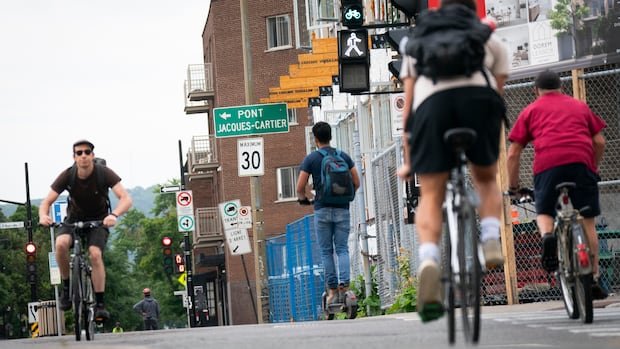

Since assuming office in 2017, Montreal Mayor Valérie Plante has overseen a 35 per cent expansion of the city’s cycling network, adding 280 kilometers. Montreal currently boasts 1,082 kilometers of bike paths, prompting some citizens to question the abundance of bike lanes, with certain mayoral candidates capitalizing on discontent towards cycling infrastructure. As voters increasingly prioritize climate change concerns in 2025, the dichotomy between bikes and cars appears outdated, leading to minimal differentiation among candidates regarding their positions on bike paths.
Before delving into the cycling-related campaign pledges of the five mayoral contenders, it is essential to understand how bike paths impact on-street parking and businesses. According to Kevin Manaugh, an associate professor at McGill University, the expansion of bike lanes can lead to a reduction in parking spaces, a trade-off necessary for fostering healthier, happier, and less polluting urban environments. Despite concerns about the loss of parking, only 2.3 per cent of Montreal’s roadway is allocated to bike infrastructure, compared to a significant 97.68 per cent designated for cars, as per a 2025 study from McGill University’s Platial Analysis Lab.
The study highlights that certain Montreal boroughs, such as Plateau-Mont-Royal and Rosemont—La-Petite-Patrie, lack adequate bike infrastructure to meet the high demand for safe and comfortable cycling routes. Removing space for bike lanes is unlikely to significantly alleviate traffic congestion, as emphasized by David Beitel from Eco-Counter, citing high bike traffic volumes at key intersections in Montreal. With between 475,000 and 515,000 parking spots across the city, Montreal repurposed 5,834 on-street parking spaces between September 2018 and September 2022 to enhance road safety and develop the Réseau Express Vélo (REV).
For car-dependent voters, transitioning to cycling may pose challenges without viable alternatives. A 2021 study from the University of California, Davis, suggests that while improved bike infrastructure generally benefits retail and food services, it may negatively impact car-centric businesses. Montreal business owners affected by construction-related accessibility issues may find the long-term benefits of bike paths hard to accept.
Mayoral candidates have varied stances on cycling initiatives, with promises ranging from expanding bike-sharing services to reassessing existing bike paths before committing to further developments. Regardless of their individual approaches, candidates acknowledge the importance of enhancing the city’s cycling network. Each candidate offers distinct proposals, from conducting audits on current bike paths to introducing new safety measures and expanding bike infrastructure in residential areas.
As Montrealers prepare to elect their next mayor, the debate over balancing bike paths, parking spaces, and traffic flow continues to shape municipal discourse, reflecting the evolving urban landscape’s complexities.