
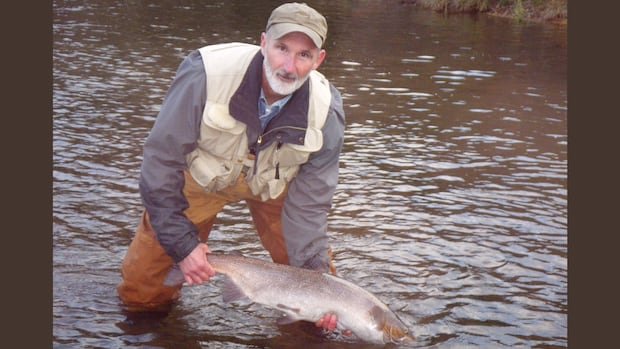

A federal advisory committee has broadened its list of imperiled Atlantic salmon populations, sparking concerns among conservation organizations in Cape Breton. There are worries that this change could result in the cessation of recreational fishing for a significant species along most of New Brunswick, Prince Edward Island, and Nova Scotia. While the Department of Fisheries and Oceans acknowledges this as a potential outcome, they emphasize that it is not an inevitable conclusion.
The updated assessment status was revealed during recent federal fisheries meetings with stakeholders following a reassessment of salmon populations by the Committee on the Status of Endangered Wildlife in Canada (COSEWIC). This reassessment included populations along Nova Scotia’s entire coast and throughout the southern Gulf of St. Lawrence.
Rene Aucoin, president of the Cheticamp River Salmon Association, expressed surprise at the designation of the western Cape Breton river’s salmon population as endangered, citing a decade of robust population growth. He highlighted that the situation is different on the Atlantic coast of Nova Scotia, where salmon populations are indeed struggling.
Bill Hailey, vice-president of the Margaree Salmon Association, echoed Aucoin’s sentiment, noting the stark contrast between the declining salmon populations in New Brunswick’s Miramichi River and the healthy state of the Margaree River.
Both Hailey and Aucoin are concerned that the committee may advocate for adding the Nova Scotia and southern Gulf salmon populations to the Species at Risk Act, potentially leading to the cessation of recreational angling activities. While the process of listing a species as endangered under federal legislation is complex and time-consuming, public consultation involving various stakeholders would be integral to any decision.
Despite the conservation concerns raised by COSEWIC, Robert Jones, DFO’s manager of biodiversity management in the Gulf region, emphasized that decisions regarding listing under the Species at Risk Act are multifaceted, considering scientific advice alongside socio-economic factors. While there is a conservation imperative, the final outcomes remain uncertain.
DFO launched an Atlantic salmon conservation strategy to restore fish stocks, although critics argue that the strategy lacks adequate funding. COSEWIC will present recommendations to Environment and Climate Change Canada in the fall, with the process incorporating economic, conservation, social, and Indigenous perspectives.