
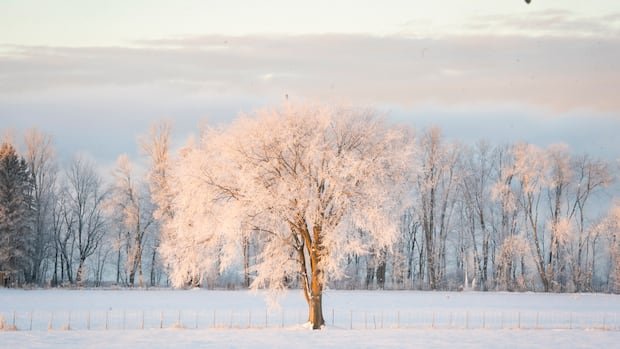

Less than a month into 2026 and now the issue of exploding trees has surfaced amidst all the ongoing events?
Not entirely.
A significant cold wave is affecting much of Canada and the northern United States, with temperatures plunging below –20°C, reaching as low as –40°C with wind chill in certain areas across these regions in the upcoming days.
While residents in these regions prepare for the severe cold, caused by a disruption in the polar vortex pushing Arctic air into the U.S. Deep South, a viral social media post suggested that temperatures could drop enough in seven states, from North and South Dakota to Michigan, to potentially lead to trees exploding.
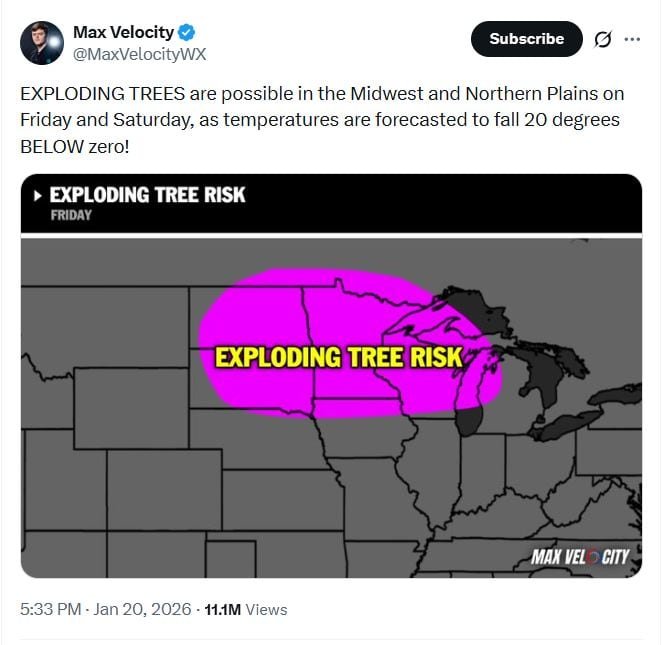
The extreme cold weather poses a serious risk to residents and is expected to contribute to a widespread and potentially perilous storm affecting nearly 30 states from Friday to Monday, although the concern about trees exploding is not necessarily valid.
Minnesota’s Department of Natural Resources addressed the circulating claim about trees exploding in Minnesota due to the extreme cold in a Facebook post, reassuring that there is no need to avoid the woods to prevent this risk.
However, there is some truth to the claim. Here’s a brief explanation of the potential for “exploding trees” in this harsh weather and how extreme temperature shifts can cause unexpected outcomes.
How is this phenomenon possible?
According to Simon Peacock, an ISA-certified arborist at Green Drop Tree Care in Winnipeg, when temperatures rapidly drop, it can lead to frost cracks, particularly common in trees with thin bark, especially in the Prairies.
These vertical splits can extend along the trunk’s length and can produce a loud noise akin to an explosion when they occur.
Bill McNee, a forest health specialist with Wisconsin’s Department of Natural Resources, explained that the sudden cold causes the water and sap inside the tree to freeze rapidly, which expands quickly, similar to ice cubes in a freezer.