
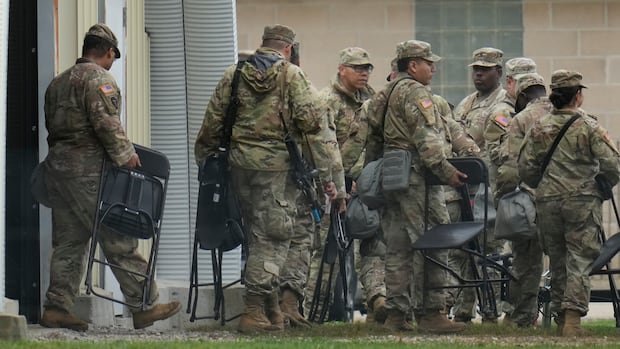

A federal judge in Chicago has decided to temporarily halt U.S. President Donald Trump from sending hundreds of National Guard soldiers to Illinois. This decision comes shortly after another judge blocked a similar deployment in Portland, Oregon. U.S. District Judge April Perry expressed concerns that allowing Guard troops in Illinois could escalate tensions, following extensive arguments from lawyers representing the U.S. government and the state of Illinois, which had filed a lawsuit against the Trump administration over the deployment.
Judge Perry announced that her detailed written order will be released on Friday. Earlier on Thursday, Guard soldiers were observed patrolling near a suburban Chicago immigration facility that has been a focal point of recent protests. Meanwhile, in San Francisco, a three-judge panel at a federal appeals court indicated a possible overturning of the ruling that blocked Trump’s deployment in Portland, potentially paving the way for soldiers to enter the city.
The rulings in these cases hold significance for Trump’s efforts to deploy military personnel in U.S. cities against the opposition of Democratic leaders. Government attorneys argued in both courts that National Guard troops were necessary to safeguard federal officers and properties from demonstrators. However, the Democratic governors of Illinois and Oregon accused Trump of distorting peaceful protests as violent to justify these deployments.
In her decision, Judge Perry raised doubts about the government’s claims of violence during the protests at the Broadview, Illinois immigration facility. She referenced a separate ruling by another Chicago judge that temporarily restricted federal agents from using force to disperse crowds. Perry attributed the protests to the actions of U.S. Immigration and Customs Enforcement (ICE) officers and cautioned against deploying Guard soldiers, stating it would exacerbate the situation.
The order issued by Judge Perry will remain effective at least until October 23. The White House plans to challenge the ruling, with spokesperson Abigail Jackson emphasizing Trump’s stance against lawlessness in American cities. Illinois Governor JB Pritzker reaffirmed that there is no credible evidence of rebellion in the state and criticized the notion of deploying the National Guard in cities like Chicago.
In San Francisco, during the appellate court session, Oregon Assistant Attorney General Stacy Chaffin contested Trump’s portrayal of Portland as a violent city, labeling it as disconnected from reality. The judges deliberated on whether to consider past protests that temporarily closed ICE’s Portland headquarters, with U.S. Circuit Judge Ryan Nelson emphasizing the need for a broader perspective beyond day-to-day assessments.
The National Guard, typically under the control of governors and primarily involved in disaster responses, is not usually engaged in civilian law enforcement according to U.S. law. Trump’s deployment of Guard troops to cities controlled by political opponents tests the boundaries of presidential authority. Trump has expressed intentions to expand troop deployments to combat perceived violence in various U.S. cities, including Washington, D.C., Los Angeles, and Memphis, Tennessee.
The president reiterated his commitment to confronting what he termed as left-wing domestic terrorism and violence during a cabinet meeting. Trump mentioned the presence of troops in Memphis and plans for deployments in Chicago and other cities. Notably, a Los Angeles trial court previously ruled Trump’s Guard deployment during the summer as illegal, a decision being appealed by the administration.