
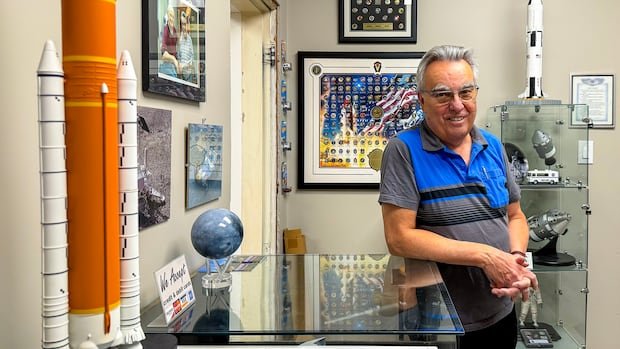

At his workspace in a car repair shop in downtown Dawson Creek, Nick Proach has just completed his latest miniature masterpiece – a scaled-down version of Skylab, the first U.S. space station. This model, which includes small solar arrays, a command module, and a telescope mount, measures a mere 30 inches (76 centimeters), significantly smaller than the actual Skylab’s 100 feet (30.5 meters). Despite its diminutive size, the replica is meticulously crafted, mirroring the precision evident in the dozens of other miniature spacecraft that adorn the display cases in his vicinity.
Expressing his enthusiasm for space exploration, Proach describes orbiting the Earth and journeying to the moon as the most thrilling adventures. With over five decades dedicated to recreating significant milestones in space travel and crafting specialized models for prominent clients worldwide, Proach’s passion for spaceflight is deeply ingrained.
Growing up in Toronto during the intense Space Race era of the 1960s, Proach was captivated by the early astronaut missions that unfolded on his TV screen. By the age of 10, he was already constructing models using materials like cardboard, plastic scraps, toothpicks, and toy tires. A pivotal moment for him was when he saw an image of the lunar rover intended for the Apollo 15 mission, inspiring him to embark on his model-making journey.
Transitioning to British Columbia in the late 1970s, Proach settled in the Lower Mainland, balancing a career in real estate with his passion for crafting models. By the mid-1980s, his reputation soared, leading to significant commissions for Vancouver’s Expo 86, including a 15-foot (4.5-meter) model of the U.S. space station Freedom and a 28-foot (8.5-meter) rendition of Canada’s proposed MSAT satellite.
In a pivotal moment in 1994, Proach’s career trajectory altered when a small advertisement he placed in a U.S. magazine attracted the attention of collectors, museums, and aerospace contractors globally. Subsequently, he transitioned to full-time model-making, establishing a company that caters to esteemed clients such as NASA, the U.S. Air Force, and SpaceX.
Each model meticulously replicates the original spacecraft, adhering to exacting standards from blueprint design to the final product. Produced in Virginia, printed in the Netherlands, and then shipped to Canada, these models are a testament to Proach’s dedication and craftsmanship.
Renowned space historian Robert Pearlman, based in Houston, Texas, acknowledges Proach’s exceptional skill, having encountered an eight-foot-tall (2.4-meter-tall) Saturn V rocket replica at a conference in 1999. Pearlman underscores the uniqueness of Proach’s models, emphasizing their role in representing iconic space artifacts for enthusiasts.
Proach’s museum showcases a variety of models, including a detailed Apollo 11 lunar module autographed by Buzz Aldrin and a model of Artemis, NASA’s upcoming crewed mission to orbit the moon, featuring a Canadian astronaut. As Proach aims to incorporate more Canadian aerospace history into his museum, he hopes to inspire young visitors to engage in hands-on activities and foster a passion for space exploration.
A treasured possession of Proach’s, a mission patch flown aboard the space shuttle Atlantis in 2002, serves as a poignant reminder of his impactful contributions to the space community. Reflecting on the significance of this patch, which completed 171 orbits and traveled over 4.1 million miles (6.5 million kilometers), Proach underscores the unexpected joy of its return to him.
Having relocated to Dawson Creek in 2020 to be closer to family, Proach remains committed to sharing his passion for space exploration with visitors, particularly children. Encouraging youngsters to pursue hands-on activities and step away from digital devices, Proach emphasizes the importance of engaging in creative endeavors, a sentiment he believes is crucial in today’s technology-driven world.