

Mae Martin acknowledges the perplexity you might feel about the happenings in Tall Pines, the fictitious Vermont village featured in “Wayward,” a new Netflix series Martin conceived, scripted, and stars in.
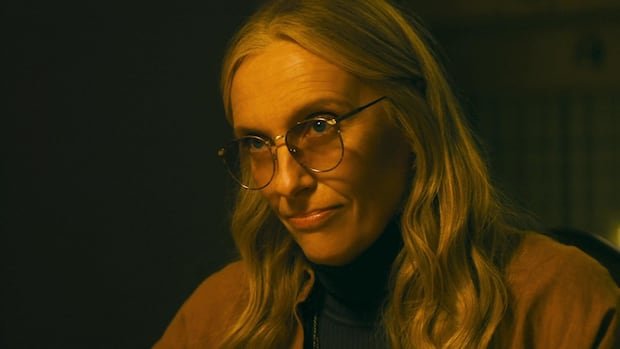
One enigma is the cryptic statement by the serene headmistress Evelyn Wade (portrayed by Toni Collette) to the teenagers in her care at Tall Pines Academy, a quasi-cult school for troubled youths, about their mother possessing a door in her mouth.
Another mystery unfolds when Alex Dempsey (played by Martin) witnesses his pregnant spouse, Laura (enacted by Sarah Gadon), wandering into the lake shortly after their return to Tall Pines, Laura’s hometown. The school’s students insist something sinister lurks behind closed doors. Canadian teens Abbie (Sydney Topliffe) and Leila (Alyvia Alyn Lind) appear to be the sole individuals willing to take action.
Martin understands the potential puzzlement regarding the show’s tone. The dark ambiance of “Wayward” diverges from their typically lighthearted roles, such as on the British panel show “Taskmaster” and in various comedic endeavors.
The series, which premiered at the Toronto International Film Festival before landing on Netflix, swiftly ascended to the top spot in the streamer’s global TV category for English series.
“Wayward” thrusts Canadian culture into the limelight, alongside other Canadian productions like “Kpop Demon Hunters.” However, unlike the latter, “Wayward” prominently showcases its Canadian origins. The narrative follows the experiences of newcomers Alex, Abbie, and Leila in the peculiar town of Tall Pines.
The show delves into themes of adolescence, identity, and a sense of foreboding, all while emphasizing its Canadian roots explicitly. Intimacy as a source of terror is a central motif, resonating with other works exploring similar concepts.
Despite commendable performances by Martin and Collette, the series occasionally meanders, leaving key mysteries unresolved and introducing subplots that do not significantly progress the storyline.
While “Wayward” exhibits promise, particularly with its poignant conclusion, it falls short of achieving greatness in its current iteration.
Share
Read more